
Now that two of London’s top boys’ independent schools, Westminster School and King’s College School, have announced they will admit girls from 2026, a common question parents ask is what that means for boys’ places. There is a common perception that there are less places for boys than for girls and now, many wonder where all the boys who might find it even harder to get into Westminster or King’s College Wimbledon are supposed to go.
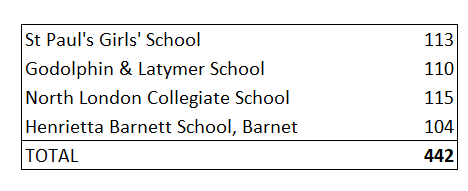
On the surface, it does seem as if there are less boys’ schools to begin with – particularly in Central London – although interestingly, a more careful look at the data shows that there are far more places for boys than for girls. Many of the girls’ schools are relatively small with an average year group size of 100 -120 girls, whereas many boys’ schools have average year group sizes of 160 – 200 boys, if not higher. If you want the data, here is an exact breakdown of numbers for the top 4 boys’ and girls’ schools in London (ranked by 2024 GCSE results):
Top 4 girls’ schools – year group size in Year 11:
Top 4 boys’ schools – year group size in Year 11:
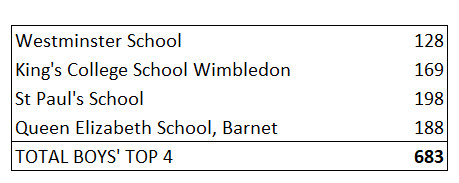
If you look at the top 4 schools only, there are 241 more places at the boys’ schools combined (683 vs 442). This is not a fluke but indeed even more pronounced when you look at the top 10 in each category: there are 1,157 places combined in the top 10 girls’ schools vs 1,762 at the boys’ schools – a whopping difference of over 600 places!
Even after KCS and Westminster start admitting girls, the discrepancy will remain significant. I remember a discussion I had with a mum whose son had gotten into Latymer Upper many years back. She was convinced that it was much harder for boys to get in than it is for girls – a common perception. I challenged her to think about why it is then that those boys do not outperform girls at their schools. If it is much harder for them to gain a place, surely, they should perform higher academically once at school? She replied the only reason they do not is because they are lazier, even though they are actually “better”.
Let us look at Latymer Upper as the highest ranked co-educational school in Central London more closely. According to our GCSE ranking based on 2024 results, it stands at #13 in London as the top co-ed school. There happen to be exactly six girls’ schools and six boys’ schools in places 1- 12: for the girls, the top 4 named further above plus Lady Eleanor Holles and City of London School for Girls, altogether with 644 places. For the boys, the top 4 boys’ schools named above plus St Olave’s Grammar and Wilson’s School, altogether totalling 1,000 places! I could even exclude the grammar schools, as they are located on the outskirts of Greater London and you might say that they are not accessible to candidates living close to Latymer Upper School. Looking at private schools only, there are four girls’ schools ranked higher than Latymer Upper with 540 places and three boys’ schools with 500 places in total.
Just behind Latymer Upper, we can match a few well-known boys’ and girls’ schools that are located in close vicinity of each other:
- UCS Hampstead with 180 boys per year group versus South Hampstead High School with only 90 girls
- Hampton School in Southwest London with 190 boys per year group versus its sister school next door, Lady Eleanor Holles, with 105 places
- Habs Girls 140 places, Habs Boys 160
- Over in Dulwich, JAGS with 133 girls per year group versus Dulwich College with 230!
Looking at these numbers, one may start to wonder if more boys attend private schools in London than girls. On a national level, this is certainly true, as 48% of pupils in independent schools are girls versus 52% boys.
Why does it still seem to many parents that there are less places for boys? It could be because boys’ schools have many different entry points – 7+, 8+, 11+ and 13+. Looking at one entry point only, it may well be true that there are less places at that entry point when compared with a girls’ school at 11+. Given that there are a roughly equal number of female versus male applicants in any cohort, it should not make it more difficult for boys, but it could seem that there are less places. This could be especially true at 7+ or 8+ when many will try and then try again at 11+ if unsuccessful.
This spread across different entry points also creates confusion, as many are unsure if they should apply at 11+ or 13+ and if it may be easier at one versus the other. Unfortunately, the answer to this question can vary by school, and senior schools do not usually want to answer that question honestly. Many prep school Heads might be able to steer parents in the right direction, but my experience is that not all give optimal or accurate advice to parents.
Long term, I expect all these schools will have to move towards 11+ entry for the majority of candidates if they want to truly establish themselves as co-educational schools. I do not expect many girls to hold out till 13+ if they have attractive 11+ offers at hand. In the meantime, Westminster Under will admit girls at 11+ for the first time in 2026, and the one thing we can know for sure already is that this will be a very competitive process for both boys and girls.